The FHA board seeks to work with all stakeholders on the lake to ensure the safety of everyone who uses the lake, whether recreationally or commercially. As part of that commitment, we would like to do our part to help educate users of the lake by sharing information and resources on this page.
Phone Numbers – Emergency 911 – Please inform 911 early in the call if you believe Harbor Patrol is going to be needed for the emergency. Then place a follow-up call directly to the Harbor Patrol on 206 684 4071 or VHF 16. The police non-emergency number is 206 625-5011.
Lake Union Boating – All vessels operating on federally regulated waters in the City of Seattle, must be in compliance with all Federal, State, and local equipment requirements. Read about speed limits on local waters, accident reporting, navigating draw bridges, rules for scuba divers and water skiers, and much more at https://www.seattle.gov/police/community-policing/boating-and-water-safety
Speed Limits 7 Knots – In Lake Union, Salmon Bay, Union Bay, Portage Bay, Lake Washington Ship Canal, and within 100 yards of any shoreline, pier, restricted area, or shore installation in Lake Washington. This speed limit drops to 3 knots in any established marina or established boat moorage area
No Wake Zone – In Lake Union and the Ship Canal area exceeding the speed limit and/or throwing up a large wake, will get the attention of Harbor Patrol. The residents along the Ship Canal and Lake Union call the Harbor Patrol when a large wake rolls by. Many of the residents have the Harbor Patrol’s phone number on their speed dial or have a VHF radio handy (206 684 4071 or VHF 16). Most boats can’t move without producing a wake, but you are responsible for any damage your wake causes. Over the years there have been several accidents and injuries caused by boats producing a large wake while still under 7 knots, as well as damage to the docks, marinas, and houseboats that surround the lake. Please show consideration to other users of the lake, and wait till you are on Lake Washington or out in the Sound before you speed up.
Lake Union Test Course – This is the course between the two yellow buoys situated in a line running east/west in the middle of the lake. The speed test area is only to be used during daylight hours, no vessel should operate at a speed in excess of 7 knots in the area immediately prior to making a U-turn. No vessel or water sports craft shall enter the speed test area and exceed the 7-knot limit if any other vessel or water sports craft is presently using the speed test area at a speed in excess of 7 knots. No vessel or water sports craft shall make more than 4 runs in or across the speed test area during a two-hour period. The speed test area is intended for brief and limited use and shall be used ONLY for vessel testing by individuals maintaining or selling vessels.
Flashing White Buoys – There is a line of seasonal white buoys that runs north to south in Lake Union to indicate a designated landing strip for floatplanes. The seaplane landing zone on Lake Union is in effect Memorial Day through Labor Day. When they start flashing it means a floatplane is coming into land. Avoid the buoys when they are flashing. Don’t tie up to these, or the red and green navigational buoys at any time.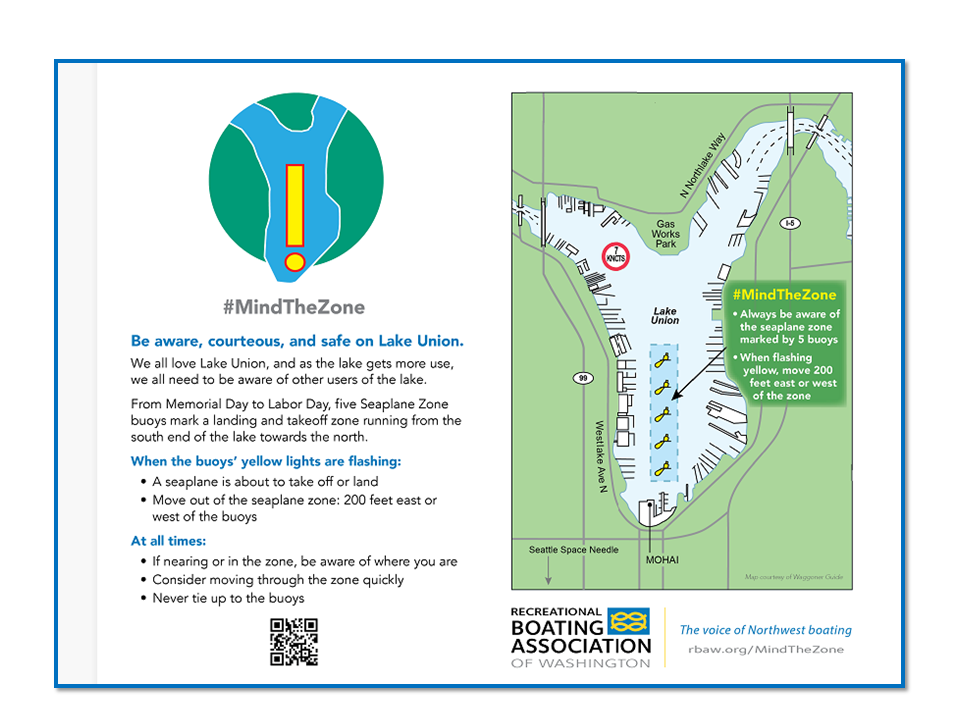
Gravel Barges – Watch out for the very large barges that are pushed down the Ship Canal, around Gas Works Park, and through Lake Union by tugboats – they are tricky to steer, they cannot stop, and they will expect you to get out of their way.
Washington Boating Laws – To ensure your safety on the water, as well those around you, it is important that boaters be familiar with state laws related to vessel operation. Learn about proper fueling, how to secure a boat to a trailer, the right way to launch a boat into the water, the navigational rules for different types of watercraft, how to share water safely with other watercraft, the steps for handling bad weather, and boating emergencies. Don’t operate a vessel on the waters of Washington state while impaired or intoxicated through the consumption of either alcohol or drugs. Learn more about Washington State boating laws at https://boat.wa.gov/boating/the-laws/.
Life Jackets Laws – Washington State encourages all boaters, adults, and children, to wear a life jacket when boating, in the case of a boat capsize or other boat accident. The U.S. Coast Guard estimates that life jackets could have saved the lives of more than 80 percent of boating fatality victims. Life jackets are required to be carried (one per passenger) by all vessels, including canoes, kayaks and paddleboards, and children under 12 must wear one at all times on boats less than 19 feet in length. Learn more about Washington State life jacket laws, find a map of loaner life jacket locations, or get information buying life jackets at a discount, or getting a free life jacket at: https://boat.wa.gov/boating/equipment/life-jackets/
Mandatory Boater Education Card – A Washington State Boater Education Card must be carried if you operating a boat 15 horsepower or greater. To get a boater education card, you can take an approved boater education course. You must be 14 or older to operate a boat. Learn more about the Washington State Boater Education Card at https://boat.wa.gov/boating/boaters-card/
Register your boat – To navigate, operate, employ, or moor a motorboat or sailboat in Washington State, you must have a Washington title, registration card, and registration decals. A license is not required for a canoe, kayak, or any vessel not propelled by a motor or sail, or the vessel is less than 16 feet in length and has a motor of 10 horsepower or less. Learn more about Washington State boat registration at https://www.dol.wa.gov/vehicleregistration/registerboat.html
Fire Extinguishers – Fire extinguishers are required on vessels with an Inboard engine, vessel length of 26 ft or longer, closed compartments where portable fuel tanks may be stored, double-bottom not sealed to the hull or which are not completely filled with flotation material, closed living spaces, closed storage compartments in which flammable or combustible materials may be stored and permanently installed fuel tanks.
Boating Accidents – The operator of a vessel involved in a boating accident, or the owner of the vessel reporting for the operator, must complete and submit a written boating accident report within 48 hours if a person dies or disappears from the vessel under circumstances that indicate death or injury, a person is injured and requires medical treatment beyond first aid, damage to the vessel(s) or other property exceeds $2,000.00 or there is complete loss of a vessel. For any other accidents, the report must be submitted within ten days.
Anchorage in Seattle – Short-term anchorage is approved in Andrews Bay on Lake Washington. The approved area is defined by two buoys marked with “A” indicating the northwest and southwest corners of the anchorage zone. Shore markers note the northeast and southeast corners. Anchorage is limited ONLY to this area. It is not permitted to drop anchor in Lake Union or Portage Bay.
Boating and Water Safety Information. Find information about boating and water safety, affordable life jackets, drowning risks, river safety, swimming safety, and more on the Seattle-King County Public Health website at: https://www.kingcounty.gov/depts/health/violence-injury-prevention/water-safety.aspx
Water Paddling Sports Safety Tips. American Canoe Association (ACA) is a national nonprofit organization that provides education related to all aspects of paddling sports for competition and recreation. ACA has 30,000 members and over 300 Clubs and Affiliates across the United States and abroad. The heart of the ACA is the people who paddle, cherish, protect, and enjoy the diverse waterways of America. Get educational resources on a variety of paddling topics: https://www.americancanoe.org/page/Resources
National Safe Boating Week May 22-28, 2021 – Every May, the National Safe Boating Week campaign reminds boaters and paddlers about the importance of safe boating. National Safe Boating Week is coordinated each year by the National Safe Boating Council and its boating safety partners across the U.S. and Canada. According to Washington’s recreational boating accident data, in the last five years, trends show most accidents and fatalities happen between May and August, and 75 percent of fatality victims were not wearing a life jacket. More information and safety tips: https://parks.state.wa.us/CivicAlerts.aspx?AID=616
Proposed Kayak Regulations – A Washington boating bill aims to regulate human-powered watercraft in the same way as motorboats. House Bill 1018 would require canoes, kayaks and paddleboard participants to take a boater education course, pass an exam and carry a boater education card. The bill had a hearing on Jan. 20 in front of the House Community & Economic Development committee. It has yet to be scheduled for an executive session, a key step before the bill can be brought to a vote.